
The California Golden Monkey
The California golden monkey (Macaca aurifera) is the only primate known to have been native to the state of California. A medium-sized, highly social monkey with a thick golden-brown coat, it once ranged throughout the oak woodlands and chaparral canyons of the western Sierra Nevada foothills.
| Species Profile | |
|---|---|
| Scientific name | Macaca aurifera |
| Common names | California golden monkey, foothill monkey, "camp robber" |
| Size | 18–24 in. (body), tail 10–14 in. |
| Weight | 11–20 lbs. |
| Habitat | Blue oak woodland, foothill pine, riparian canyons, 500–4,000 ft. |
| Diet | Acorns, manzanita and toyon berries, wild grapes, insects, bird eggs |
| Social structure | Troops of 12–30 led by older females |
| Status | Extirpated from the wild (last confirmed 1911) |
Natural History
Golden monkeys were most active in the early morning and late afternoon, spending the heat of the day resting in the shade of oaks along creek beds. In autumn, troops gathered in large numbers beneath valley and blue oaks to feed on acorns, caching surplus nuts in rock crevices and hollow trees. Because many of these caches were never recovered, the monkeys are believed to have played an important role in spreading oak woodland uphill and across canyons.
Troops communicated with a wide range of calls. Early settlers described a distinctive "barking chatter" that could be heard echoing across the canyons at dawn, and several mining-camp diaries mention being woken by it.
Decline and Disappearance
The arrival of the Gold Rush in 1848 transformed the foothills almost overnight. Within two decades:
- Hydraulic mining washed away entire hillsides and buried creek habitat under sediment.
- Oak woodlands were cleared for fuel, mine timbers and grazing land.
- Golden monkeys were hunted for meat, captured for traveling shows, and shot as pests for raiding camp supplies.
By the 1880s, reports had become rare. The last confirmed sighting was made in 1911 by a surveyor working near Coloma, who described "a small troop of yellow monkeys, perhaps six, moving through the oaks above the river." No specimen was collected.
Could They Still Be Out There?
Every year, California Monkey Watch receives hundreds of reports from hikers, ranchers and foothill residents. While none has yet been confirmed, our staff take every report seriously. Large areas of remote canyon habitat remain lightly surveyed, and the species' shy, crepuscular habits would make a small surviving population difficult to detect. Regardless of whether any monkeys remain, our position is the same: the habitat must be ready.
Historic Range
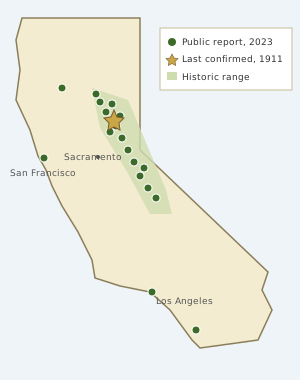
Shaded area shows the historic range in the western Sierra foothills.
Identification Tips
- Golden-brown to tawny coat, paler on the chest
- Dark, hairless face with a short muzzle
- Medium-length tail, often carried in a loose curve
- Usually seen in groups, rarely alone